
















Hello, your privacy is important to us. Uniview websites use cookies to store info on your device and create the most secure and effective website . By continuing to use our websites, please accept the cookies could be stored on your device, which outlined our cookie policy and privacy policy .






_1036463_651984_0.png)





 X
X
 GLOBAL / ENGLISH


A night vision camera and a full color camera can both protect a site after dark, but they solve different imaging problems. Traditional infrared night vision prioritizes dependable visibility when almost no visible light is available, usually producing monochrome video. A full color camera preserves color information by combining a sensitive sensor, a large aperture, image processing, and, when necessary, warm supplemental light. The better choice therefore depends on the evidence the operator needs, the amount of ambient light, the acceptable level of visible illumination, and the distance to the subject. For an unlit perimeter, infrared often remains the safer baseline. For entrances, loading areas, and car parks where clothing, vehicle, or object color matters, full color imaging can provide more useful context. Many projects benefit from a mixed design rather than one technology everywhere.
l Choose infrared night vision for very dark areas where discreet, consistent visibility matters more than color evidence.
l Choose full color imaging where color, fine scene context, and visible deterrence can improve incident review.
l Do not compare cameras by resolution alone; sensor size, aperture, shutter behavior, WDR, illumination distance, and mounting position shape the final image.
l Test the actual scene at its darkest hour and review moving subjects, not only still frames.
l Use a hybrid layout when one site contains both unlit boundaries and partially illuminated activity zones.
An infrared camera uses IR LEDs to illuminate a scene with wavelengths outside normal human vision. The sensor records the reflected energy, and the camera typically switches to a black-and-white mode after its day/night threshold is reached. Removing color improves usable sensitivity because the camera no longer needs to reconstruct accurate color channels from a weak visible-light signal. The result is stable shape and contrast in darkness, provided the subject remains inside the rated illumination range.
IR performance still depends on scene geometry. A wall, soffit, or nearby pole can reflect infrared light back toward the lens and wash out the foreground. Dust, insects, rain, and spider webs close to the camera may appear brighter than the distant subject. A stated IR distance also describes illumination reach, not guaranteed identification detail; focal length, pixel density, motion, and exposure time remain decisive.
A full color camera collects as much visible light as possible through a large-aperture lens and a sensitive image sensor. Image signal processing then controls noise, color balance, contrast, and motion smear. When ambient light falls below the useful threshold, warm light can support the sensor and keep the image in color. This may reveal details that monochrome video cannot preserve, such as the color of clothing, packaging, doors, or vehicles.
The trade-off is that color requires photons. Without enough ambient or supplemental light, aggressive gain can create noise while a long shutter can blur a moving person or vehicle. Warm light also becomes visible within the scene, which may be useful as a deterrent but unsuitable near windows, residential boundaries, or locations with lighting restrictions.
Decision Factor | Infrared Night Vision | Full Color Camera |
Lowest-light behavior | Designed to maintain visibility in near or complete darkness with IR illumination. | Needs usable visible light or warm supplemental light to retain color. |
Image information | Clear shapes and contrast, normally monochrome at night. | Retains color cues and richer scene context. |
Visible light | IR illumination is generally unobtrusive. | Warm light may be visible and can affect neighbors or staff. |
Motion risk | Exposure can often remain practical, though settings still matter. | Long exposure in weak light can produce motion smear. |
Best-fit zones | Dark boundaries, service roads, storage yards, and low-traffic areas. | Entrances, loading bays, retail fronts, parking areas, and other activity zones. |
Main installation caution | Avoid close reflective surfaces and IR bounce-back. | Verify lighting uniformity, glare, and the effect of visible supplemental light. |
Measure the scene at the darkest operating time, not at dusk. A car park may look bright while businesses are open and become almost black after exterior lighting switches off. Full color imaging performs best when light reaches the subject evenly. Isolated bright signs can make the rest of the frame appear darker, while infrared supplies its own illumination more consistently.
Decide what a useful recording must show. If an operator mainly needs to detect movement along a dark fence, monochrome IR may be enough. If the review depends on distinguishing a red carton from a blue one, a dark jacket from a light jacket, or one vehicle color from another, full color video has a clear advantage. Color does not replace adequate pixels on target, however; it adds context only when the subject is large and sharp enough in the frame.
A still test chart can make a low-light camera look stronger than it will during real activity. Slower shutter speeds collect more light but stretch movement across multiple pixels. Higher gain brightens the image but also amplifies noise, which can reduce compression efficiency and storage predictability. During commissioning, review a person walking across the scene and a vehicle moving toward the camera. Check faces, hands, wheels, and text edges for smear rather than judging overall brightness alone.
Entrances often combine a dark interior with bright exterior light. A camera with suitable wide dynamic range can retain information in both areas, but mounting angle still matters. Avoid aiming directly into headlights or placing the brightest lamp at the edge of the lens. At night, confirm that supplemental light does not reflect from glass doors, polished panels, or wet pavement.
Color scenes with visible noise and constant movement may require more bitrate than a clean, static monochrome image. Confirm recording duration under representative night conditions and pair the cameras with appropriately sized network video recorders. Maintenance teams should clean the front glass, remove webs, check light output, and verify focus after seasonal temperature changes or bracket movement.
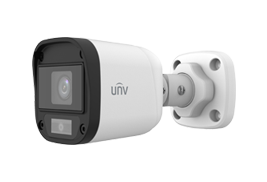
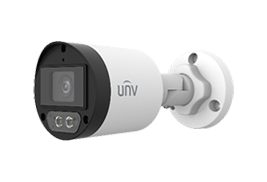
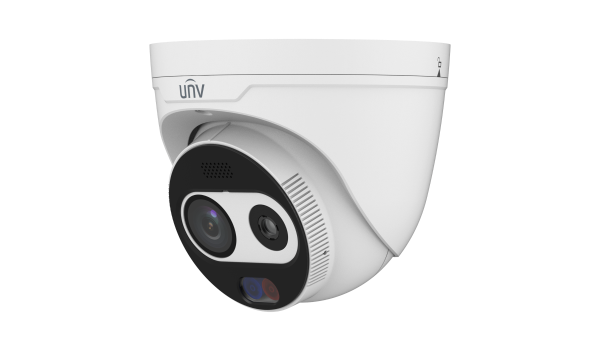
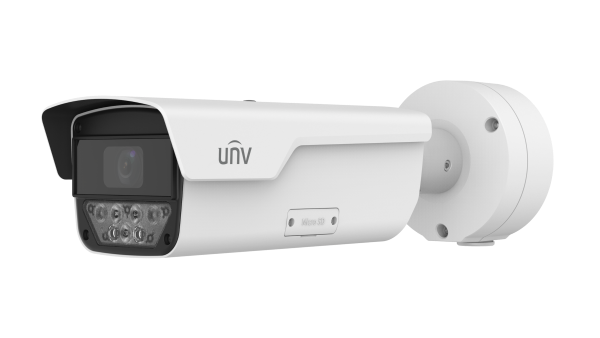
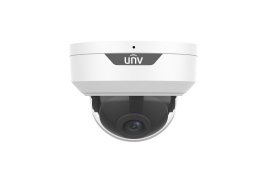
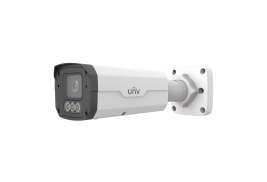
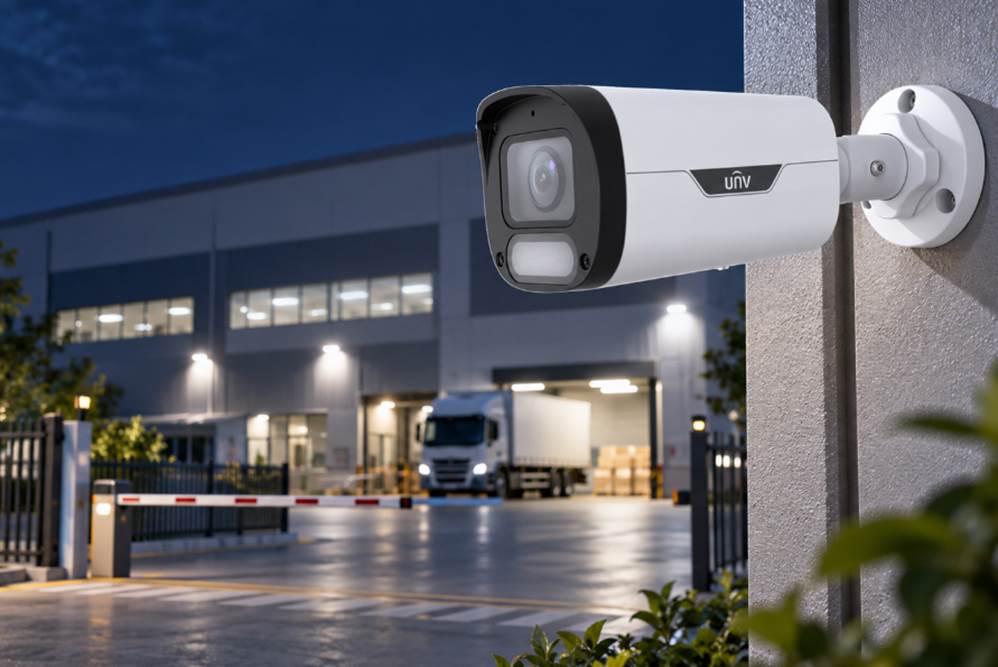
For a color-critical entrance or loading zone, the Uniview IPC2314LE-ADF28KM-WP illustrates the components that support full color night imaging: a 1/1.8-inch CMOS sensor, an F1.0 aperture, ColorHunter with Wise-ISP processing, 120 dB true WDR, and warm light rated up to 30 m. It records up to 4 MP and supports PoE, IP67 protection, and local microSD storage up to 512 GB. These specifications make it a relevant option where color evidence, backlight control, and outdoor durability must work together.
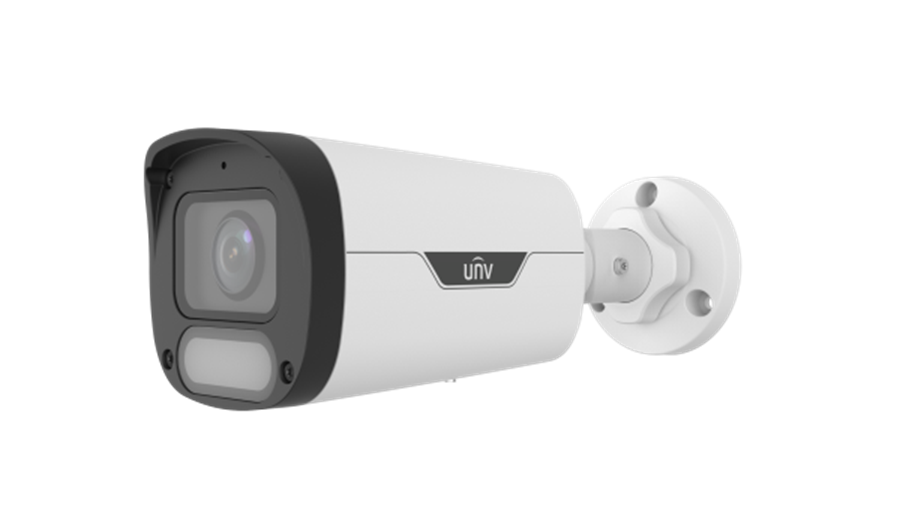 A 30 m warm-light rating should not be treated as a promise of identification at 30 m. Illumination distance, field of view, DORI distance, subject motion, mounting height, and local reflectance answer different questions. The correct lens should be selected around the target width and required detail, then validated through a night test at the actual mounting height.
Large sites rarely have one lighting condition. Use infrared cameras on fully dark boundaries and low-activity service roads, then use full color models at gates, loading bays, building approaches, and car parks where color context improves review. Keeping both camera types within a compatible network camera and recording platform simplifies configuration, playback, user permissions, and maintenance.
Two field mistakes deserve special attention. First, avoid installing a full color camera where its warm light shines into office or residential windows; change the angle, lower the output, or use infrared instead. Second, avoid placing an IR camera beneath a deep eave without checking reflection from the ceiling or wall. In both cases, a short after-dark walk test reveals problems that a daytime installation photo cannot.
l Define the night task: detection, observation, recognition, or identification.
l Record the darkest light condition and note when nearby lights switch on or off.
l Calculate pixels on target for the required subject distance and lens view.
l Test moving subjects with the intended shutter, gain, noise reduction, and bitrate settings.
l Inspect for IR reflection, warm-light glare, wet-ground reflection, and window bounce.
l Confirm storage duration, PoE capacity, weather protection, brackets, and maintenance access.
l Review the final video on the operator's actual monitor, not only on a phone screen.
It can retain color in complete darkness only if it provides or receives visible supplemental light. Without sufficient visible light, a color sensor must increase gain or exposure, which can create noise and motion blur. Where visible illumination is not acceptable, infrared night vision is usually the better choice.
Most day/night cameras switch to monochrome when using infrared because this improves sensitivity and avoids false color under IR illumination. Some dual-light designs can use infrared for routine monitoring and activate visible warm light under configured conditions, but their behavior should be checked against the site's lighting and operating policy.
Use infrared for unlit perimeter lines and remote yards where discreet coverage matters. Use full color around loading doors, vehicle routes, and staffed entrances where color evidence supports faster review. A site plan that assigns technology by zone normally performs better than selecting one camera mode for the entire warehouse.
Neither camera type is universally better. Infrared night vision is dependable in very dark scenes and avoids visible supplemental lighting. Full color imaging provides richer evidence where enough light is available or warm light is acceptable. The most reliable decision comes from defining the target detail, measuring the night scene, checking motion performance, and testing the proposed mounting position after dark.
Uniview provides network cameras, NVRs, and low-light imaging options for commercial and industrial projects. Integrators can compare sensor, lens, illumination, WDR, storage, and environmental requirements with the real operating conditions before finalizing a night security design.